

I have a confession to make. For years, my quiet time notes lived in a spiral notebook on the end table by my recliner. Every morning around six, I would read a passage, scribble a few lines in the notebook, and then spend half of Tuesday's study trying to remember which page of which book that thought belonged to. The notebook worked. It just worked badly. So when the women in my Tuesday morning group started asking about journaling Bibles, I did what I always do. I bought one and used it every day for six months before I recommended it to anybody. This is the honest review of the Zondervan NIV Journal the Word Bible, from a woman in Conway, Arkansas, who has led the same Tuesday study for twelve years and has strong opinions about paper.
I want to be clear about what this review is and is not. It is not a theology lecture, and it is not a list of every verse in the book. It is one reader's honest report on what it is like to live with this Bible, write in it, carry it to church, and hand it to a friend. If you are trying to decide whether this is the Bible for you, I hope it saves you the trouble of a return.
The Quick Verdict
The Zondervan NIV Journal the Word Bible is a genuinely good daily reader with real tradeoffs. The paper is thinner than the photos suggest, and the margins are narrower than the single column version. But the Comfort Print, the sewn binding, and the red letter make it the Bible I reach for at six in the morning.
Amazon Check Today's Price →The journaling Bible that stays open while you write
After six months of daily use, this is the one I hand to a friend who wants to start writing in her Bible. It has tradeoffs, and I cover every one of them below. Check today's price on Amazon.
Amazon Check Today's Price on Amazon →How I've Used It
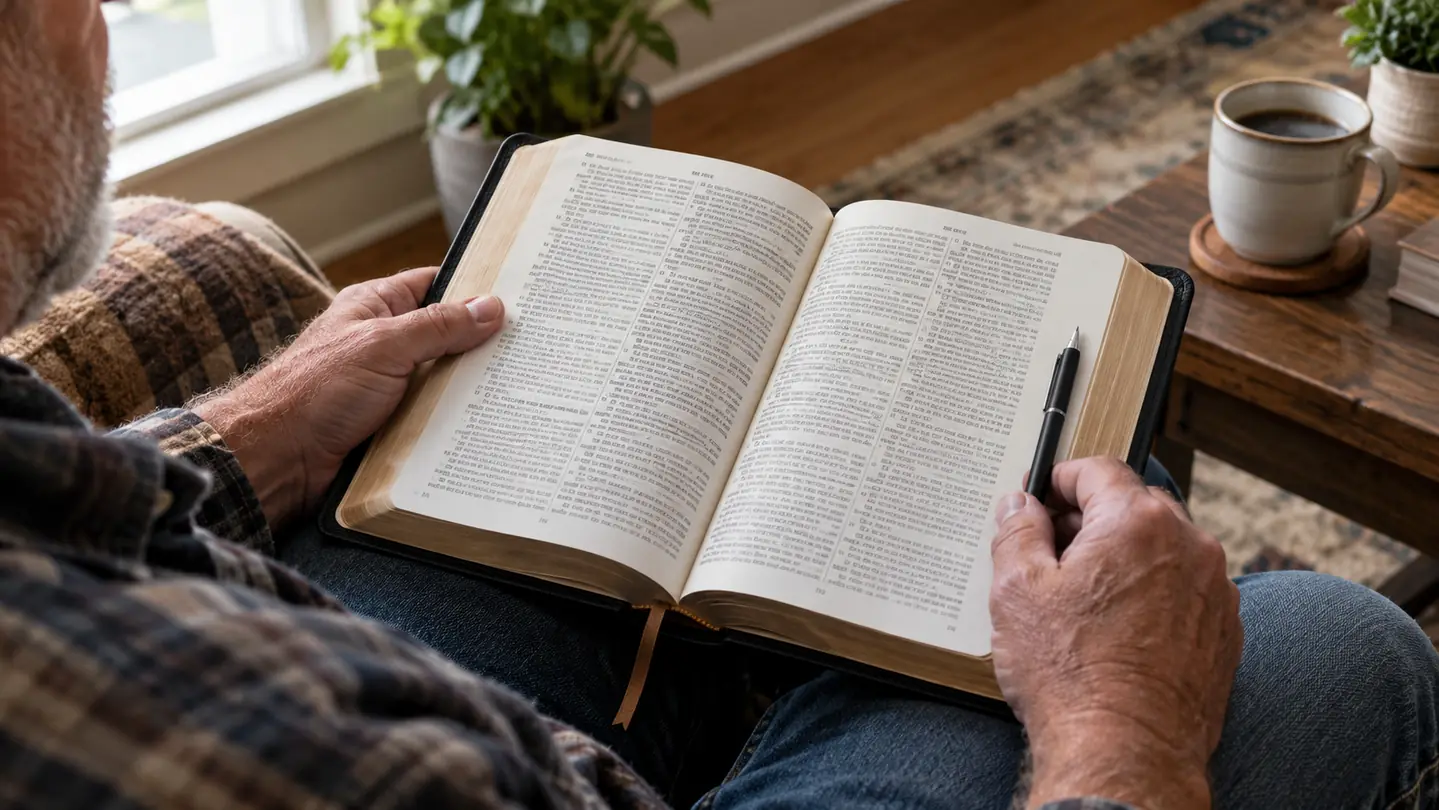
I read in a recliner by the living room window with a cup of coffee, usually around six in the morning before the house wakes up. Glenn, my husband, is usually still asleep at that hour, so the quiet time is mine. The Bible sits open on my lap, and I read a chapter or a psalm, underline a line or two with a fine tip pen, and write the thought that comes to me in the outer margin.
I also use it on Tuesday mornings. Our group is about ten women, and we have been meeting for roughly twelve years now. We read the passage aloud, and I jot down what people say, the questions they ask, the verse that made someone tear up. Those notes are gold to me. They are the difference between a Bible I own and a Bible that remembers my people.
And I have carried it to church most Sundays, which is a harsher test than people think. After a career in the church office, I have strong opinions about how a Bible should hold up on a Sunday. It goes in a tote bag with a water bottle and a stack of bulletins, and it comes out for the sermon. That is where the cover and the binding earn their keep, or fail to.
What Nobody Tells You About the Paper
Here is the honest part, the part the marketing photos do not show you. The paper in this Bible is thin. It has to be. If Zondervan had used thick art paper, the book would weigh five pounds and you would need a lectern. So they used a lighter paper, and that means you can see the shadow of the writing on the other side of the page. It is ghosting, not bleeding, and it does not make the text unreadable. But it is there, and I want you to know it before you buy.
The bigger issue is pens. A heavy gel pen, the kind with a 1.0 tip that lays down a wet line, will bleed through. I learned this the expensive way with my favorite purple pen. The fix is simple. Use a fine tip pen, 0.4 or 0.38, or a good ballpoint, or a pencil. I keep a Pilot G2 in 0.38 in my Bible case, and it has never bled through once.
The other thing nobody tells you is that the paper has a slight tooth to it, which is a fancy way of saying it grips the pen nicely. Writing in the margin feels good, like writing in a quality notebook. That matters more than you think, because the whole point of this Bible is that you write in it.
So the paper is a tradeoff, not a dealbreaker. If you are willing to match your pen to the paper, you will be fine. If you are a marker person, if you love a fat highlighter, this is not the Bible for you, and I say that with love.
The Margins Are Generous, But Not What the Photos Suggest
Here is the thing I wish someone had told me before I ordered. The wide margin you see in the product photos is the outer margin of each page. This is a double column Bible, so the text runs in two columns and the journaling space is on the outside edge. That is a good design, and it means you can write a solid paragraph beside the text. But it is not the enormous margin of the single column version.
If your dream is to write long reflections, whole essays in the margin, you want the single column Journal the Word Bible instead. I compared them side by side, and the single column gives you roughly twice the writing space per page. The double column reads more like a regular Bible, which I prefer for group reading, and it is easier to follow along when someone else is reading aloud. But the writing space is smaller, and I want you to go in with your eyes open.
The lines in the margin are already printed. They are light gray lines, and they keep your handwriting straight, which this wobbly writer appreciates. But some people want blank space, and if you are one of them, the printed lines will bother you more than you expect. It is a small thing. It is also the kind of small thing that only shows up after you own it.
One more honest note about the layout. The inner margin, the one near the spine, is tight. You will not be writing there. So on a left hand page, your writing space is the left edge, and on a right hand page, it is the right edge. The spine side is for the binding, not for your pen. That is normal for a double column Bible, but it surprised me at first.
The Cover, the Binding, and the Red Letter
The cloth over board cover is soft and pleasant to hold, and it looks exactly like the photos. It is not leather, and it does not pretend to be. After six months of daily use, Sunday totes, and the occasional coffee table landing, the corners show a little wear. Nothing alarming, nothing that affects reading, but if you want a Bible that stays pristine, this is not it. Cloth over board is a living material. It picks up the life you live with it.
The binding, though, is the best thing about this Bible. It is sewn, not glued, and it lays flat the moment you open it. That is the single most important feature for a journaling Bible. You cannot write in a Bible that snaps shut on you. This one stays open on my lap, on the table, on the arm of the recliner, and that makes the whole habit easier.
The red letter is a matter of taste, and I will be honest about the tradeoff. I love seeing the words of Christ in red when I am reading the Gospels. But red ink is harder to read in low light than black ink, and the print in this Bible, while beautifully clear, is not huge. I read with a lamp on and my reading glasses on, and then it is fine. If you read in bed with a tiny book light, the red will test your eyes.
And the Comfort Print is the real deal. I am 61, my eyes are not what they were, and this is the first Bible in years that I can read without squinting. The type is clean and dark, the letters are properly spaced, and the double column keeps the lines short enough that my eye does not get lost. That alone would make me recommend it.

How It Held Up Over Six Months
Six months is not a lifetime, but it is enough to find the weak spots. The corners of the cover show wear, as I said. The spine is still tight, the pages have not yellowed, and no pages have come loose, which is more than I can say for a cheaper Bible I owned in my forties. The red letter has not faded, and the lines in the margin have not smudged, even where my hand rests while I write.
The honest confession is this. I have filled maybe a third of the margin space in my most read books, Romans, Psalms, and John. In the books I read less often, the margins are still empty. The Bible did not make me a more disciplined journaler. What it did was make the journaling I already do more useful, because now my notes live on the same page as the verses they belong to. When a woman in my group asks me about Romans 8, I do not have to go hunting for a notebook. I turn to the page.
The wear is honest, too. This is not a Bible you will want to keep in a gift box. It is a Bible you will want to use, and using it shows. I find that comforting, actually. A Bible that looks new after six months is a Bible that was not opened.
That is the real argument for this Bible, and it is the one nobody puts in the product description. The habit is yours. The Bible just makes sure your notes are where you can find them again. I have a longer term review that goes deeper into how it wears.
What I Liked
- Lays flat the moment you open it, thanks to the sewn binding
- Comfort Print is genuinely easy on older eyes
- Red letter makes the words of Christ easy to find
- Generous outer margins for real note taking
- Soft cloth cover is pleasant to hold
Where It Falls Short
- Paper is thin, and heavy pens bleed through
- Margins are narrower than the single column version
- Cloth over board shows wear at the corners
- Heavier than a standard Bible, awkward to hold one handed
- Printed lines in the margin limit how you can use the space
After six months of six AM reading and twelve years of Tuesday morning study, this is the first Bible that kept my notes where I could actually find them again.
Alternatives I Considered
I compared this Bible to a study Bible before I settled on it, because that is the question everyone actually asks. A study Bible gives you commentary, cross references, and notes from scholars, but it leaves almost no room for your own words. I have a study Bible on my shelf. It is a good tool. But when I read it, I am reading someone else's thoughts about the text, and for my quiet time, I wanted room for my own.
I also looked hard at the single column version of this same Bible, and I have put the two side by side in a separate comparison if you want the full breakdown. The short version is this. If you want to write long reflections, get the single column. If you want a Bible that reads naturally for group study and still gives you room for short notes, get this double column one. I chose the double column, and I have not regretted it.
Who This Is For
This Bible is for the person who has been keeping notes in a notebook, on sticky notes, in the margins of a study guide, anywhere, and is tired of never finding them again. It is for the person who wants to write in her Bible but has been afraid to, because the pages of her current Bible are too thin or too full or too precious. It is for the older reader whose eyes are tired of squinting at tiny print. It is for the group leader who wants to remember what her women said about a passage.
It is also for the person who understands that a Bible is a tool, not a fix in itself. If you buy this and expect the journaling habit to appear on its own, you will be disappointed. If you buy it because you already want to write, and you just need a place to do it, you will love it.
Who Should Skip It
Skip this Bible if you are a marker person. If your quiet time involves highlighters, gel pens with fat tips, or anything that lays down a lot of ink, the thin paper will frustrate you. Skip it if you want to write long, essay length reflections in the margin. The double column margins are good, but they are not that good, and the single column version exists for a reason.
Skip it if you want a rugged, take it anywhere Bible. The cloth over board cover is lovely, and it will show the life you live with it. If you want something that shrugs off a truck console or a backpack, get a leather or a hardcover. And skip it if you want commentary. This Bible gives you room for your own words, not someone else's. For that, you want a study Bible, and I say that as someone who owns both.
The honest bottom line after six months
The Zondervan NIV Journal the Word Bible has real tradeoffs, and now you know every one of them. It is still the Bible I reach for at six in the morning, and the one I hand to a friend who says she wants to start writing in her Bible. Check today's price on Amazon and decide with your eyes open.
Amazon Check Today's Price on Amazon →