
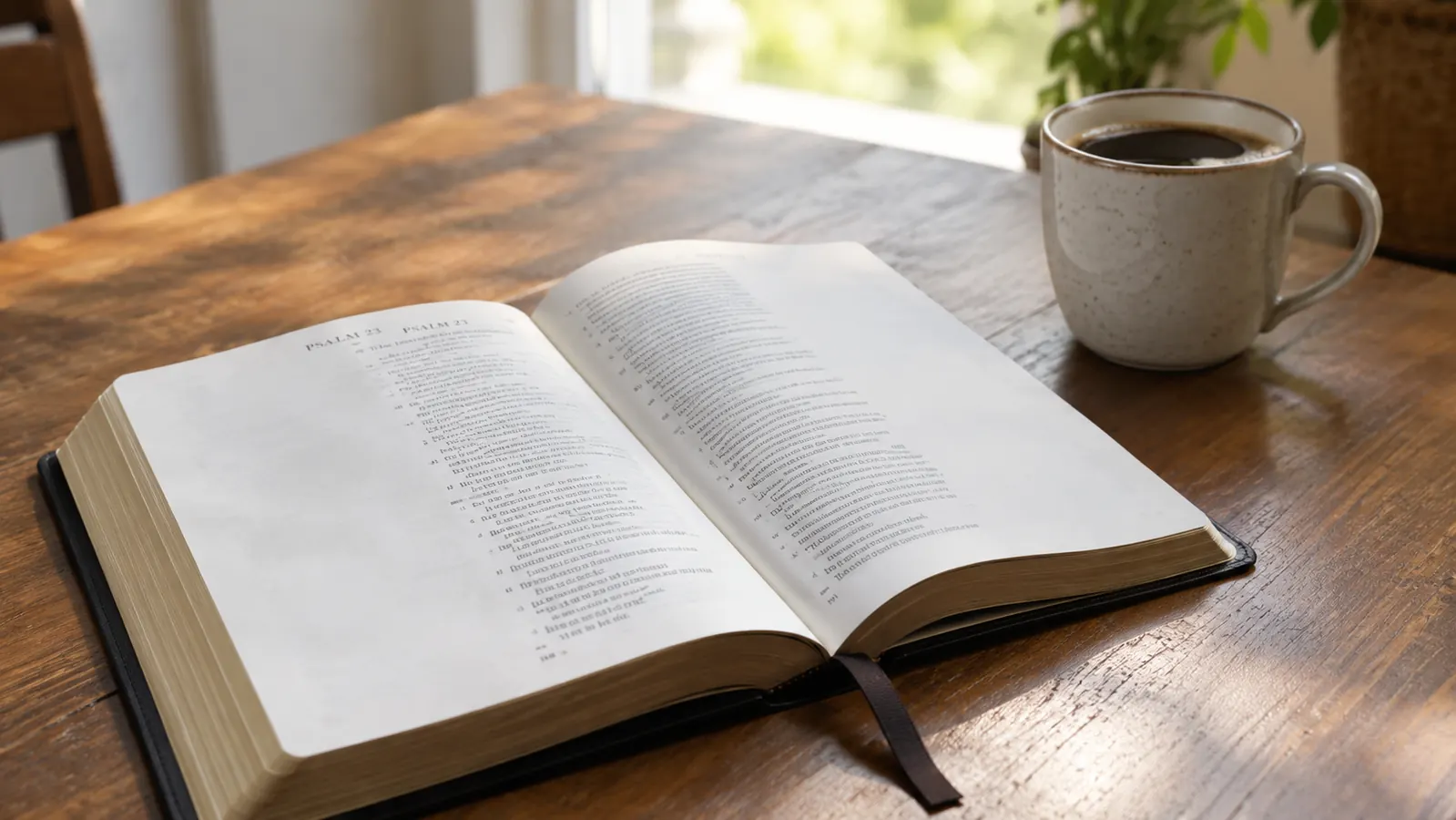
For months now, the NIV Journal the Word Bible from Zondervan has been the book I reach for first every morning. I am Darlene Whitaker, and my quiet time starts around 6 AM in a recliner by the living room window with a cup of coffee. Before this Bible, my study Bibles and my reading Bibles each did one job well, but neither one gave me room to think on the page. This one does. If you have ever underlined a verse and wished you had somewhere to write what it made you think, this review is for you.
I have used this Bible for months of daily reading, for my Tuesday morning women's Bible study, and for Sunday services. I have written in it, carried it in a tote bag, and read it at the kitchen table. What follows is the honest, long-term picture: what I love, what I have learned to work around, and who I think should buy it.
The Quick Verdict
The NIV Journal the Word Bible gives you the whole NIV text with wide, ruled margins that really are wide enough to write in. It is the Bible I reach for every morning, and the one I recommend most often to women in my study group.
Amazon Check Today's Price →A Bible you can actually write in, every single day
Months in, the wide margins still feel like the whole point. If you want a dependable NIV text with room to think on the page, this is the one.
Amazon Check Today's Price on Amazon →How I've Used It
I have used this Bible almost daily for about five months. I started the first week of January, right after our church handed out its annual reading plan, and I have missed very few mornings since. Most days I read one chapter, sometimes two, and write a few lines in the margin. Some days that means a prayer, some days a question, some days just the date and a word that stood out. On Sundays I carry it to church in the same tote bag I have used for years, and it has held up well.
I also use it when I prepare for the Tuesday morning women's Bible study I have led for about twelve years. Our group is roughly ten women, and we work through books of the Bible together. This spring we studied Romans, and I did all of my preparation in the margins of this Bible instead of in a separate notebook. That was the change that convinced me. When a woman asked a question about chapter 6, I did not have to shuffle papers. I turned two pages and there was my note from the Tuesday before.
One morning in early February stands out. I had been reading through Exodus, and when I hit chapter 14, the crossing of the Red Sea, I wrote three lines in the margin about what it must have felt like to trust God with no way out. Two days later I came back to that page while preparing for our study, and the note was still there waiting for me. That is the kind of thing that has made this Bible the one I reach for at 6 AM. It holds my place in the text and my place in my own thinking all at once.
The double-column layout took me a little time to get used to, because my previous reading Bible was single-column. For the first week I kept losing my place at the end of a line. Once I adjusted, I found the double column easy to follow, and the red letter text for the words of Christ is a feature several women in my group specifically asked about. The Comfort Print type is clear and readable in the early morning light, which matters to me more than I expected.

The Wide Margins Are the Whole Point
The reason this Bible exists is the margins, and they deliver. Each page has a ruled column on the outside edge that is wide enough for a sentence or two, sometimes three if you write small. I use a fine-point pen and I can write comfortably without the text crowding in. That is the difference between this Bible and a standard wide-margin Bible I tried years ago, where the space looked generous but the lines were so close to the text that my notes felt cramped.
The ruled lines keep my handwriting straight, which I appreciate because mine drifts without them. I have filled the margins of entire books of the Bible by now, and flipping back through those pages is like reading an old journal. I can see what I was praying about in January, what question I was wrestling with in March, and what verse I underlined the morning my grandson was born. That is the real value of this Bible: it becomes a record of your walk, not just a copy of the text.
I tried a separate journal for years, and it never stuck. I would underline a verse during my quiet time, make a mental note to write it down later, and by the time I found the journal the thought was gone. With this Bible the thought goes on the page the moment it comes, which turns out to be the whole difference. One morning in March, reading through 2 Corinthians, I filled the margin beside chapter 5 and still had more to say, so I wrote above the chapter heading. Zondervan designed these pages for exactly that kind of use, and I have learned to use every inch without it feeling crowded.
I tested three pens in the first week. The first was a medium-point ballpoint that wrote smoothly but left the page looking heavy. The second was a gel pen that dried slowly and smudged when I closed the Bible. The third, a fine-point rollerball, has been my pen ever since. That kind of trial and error is easy to do here because the paper takes ink well, and it is worth doing before you commit to a pen for a whole book of the Bible.
One honest note: the margins are wide, but they are not endless. On a page with a long passage I have to choose my words carefully, and sometimes I write in the space above the chapter heading or use the blank pages at the front and back. I have never run out of room in a way that frustrated me, but I do write smaller than I do in a notebook.
Flipping back through the margins is like reading an old journal. This Bible becomes a record of your walk, not just a copy of the text.
How the NIV Text Reads Day After Day
The NIV is the translation I have read for decades, and this edition from Zondervan does it justice. The language is clear without feeling flat, and it reads well aloud, which matters for our study group. When we take turns reading a chapter around the table, the sentences flow naturally and nobody stumbles over awkward phrasing.
One Tuesday in April, our group read 1 Corinthians 13 around the table, each woman taking two verses. The NIV carried the meaning without anyone having to stop and untangle a sentence, and the woman who had never read aloud in front of the group told me afterward that she forgot to be nervous. That is what I mean when I say the translation reads naturally. I also compared a few passages with my old New King James Bible one afternoon, and I could see why our church has used the NIV for so long. It sounds like the way we actually talk, without losing the weight of the words.
I have also read long stretches aloud by myself, the way I do when I am preparing a lesson. The NIV does not hide its meaning in old-fashioned word order. When I read the genealogy in Matthew 1, it still sounds like a list of names, but the verses around it flow the way a story should. For a study leader who reads aloud every week, that matters more than any single feature.
The red letter text is printed in a way that is easy to distinguish without being distracting. I know some readers prefer no red letter at all, but for a study group it is helpful to find the words of Christ quickly when someone asks, 'What did Jesus actually say about this?'
The Comfort Print typeface is genuinely comfortable. I read without my reading glasses more often than I expected, and the letters stay crisp even in low light. One woman in my group has the large print edition and loves it, but I have found the regular Comfort Print size perfectly adequate for daily reading.

What It's Like to Carry and Use Every Day
This is a cloth over board binding, which means the cover has a soft, fabric-like feel rather than a hard leather cover. I will be honest: I was unsure about that at first, because I have always preferred a sturdier cover. Months later, I have changed my mind. The cloth cover is pleasant to hold, it has not worn or frayed at the corners, and it lies flat when I set it on the table.
It is not a pocket Bible. It is a full-size Bible, and you will know it is in your bag. I carry mine in a tote with a study guide and a small notebook, and it fits fine. The third Sunday I carried it, a light rain caught us walking from the car to the church door. I tucked it under my jacket, and the cover dried without a mark. Another time I dropped it getting out of the car in the church parking lot, and the binding took the fall without a loosened corner. You can tell Zondervan has been making this translation for a long time: the pages are cut evenly, the spine flexes without cracking when I open it flat, and the cover has kept its shape through all of it.
The Bible also earns its place on the table between services. I leave it open to the passage we are studying, and when I walk past the living room I find myself reading a verse or two and adding a line in the margin. My husband Glenn has started asking me what I am writing about, and twice now he has read the margin notes out loud at the dinner table. It has become a family conversation piece in a way I did not expect.
The pages are a good weight. They are not tissue-thin, which is the first thing I check in any Bible. My pen does not bleed through, even when I use a gel pen, and I have not noticed ghosting that bothers me. I underline and write in the margins freely, which I could never do in my old study Bible. I tested a fountain pen once, and that one did show through, so I stick with fine-point rollerball pens and have not had a single smudge.
Who This Is For
This Bible is for anyone who has ever underlined a verse and wished they had room to write what it made them think. It is for the person who keeps a separate journal but would rather have the notes next to the text. It is for the small group leader who wants her preparation and her quiet time in one place. It is for the new believer who wants to start a habit of writing down what God is teaching her, and for the longtime reader who wants her Bible to become a record of her walk.
I have recommended this Bible to three women in my study group this year. One of them had never journaled in her Bible before and now does it every morning. Another bought it for her mother, who has trouble holding heavy books. The third is still deciding, and I told her the same thing I will tell you: if you want to write in your Bible, this is the one to get.
Who Should Skip It
If you do not plan to write in your Bible, you do not need this one. You would be paying for wide margins you will never use, and a standard reading Bible will serve you better. If you prefer a single-column layout for long reading sessions, the double column may take some getting used to, though I adjusted within a couple of weeks.
If you want a compact Bible to carry in a purse or a pocket, this is too large. And if you strongly prefer a leather cover, the cloth over board binding may not feel substantial enough for you, even though it has held up well for me. None of these are flaws in the Bible itself. They are simply honest reasons why it might not be the right fit for you.
What I Liked
- Wide, ruled margins that are genuinely big enough to write in every day
- Clear NIV text with Comfort Print type that is easy to read in low light
- Red letter text for the words of Christ, helpful for study groups
- Pages hold up well to ink, with no bleed-through from my pens
- Cloth over board cover has worn beautifully over months of daily use
Where It Falls Short
- Double-column layout takes some getting used to if you prefer single-column
- Full-size Bible, not a compact edition for carrying in a purse
- Cloth cover may not feel as substantial as a leather binding
- Margins are wide but not endless; long passages require smaller handwriting
Give your quiet time room to grow on the page
Months of daily use have convinced me: if you want to write in your Bible, this is the one. See today's price on Amazon and decide for yourself.
Amazon Check Today's Price on Amazon →